“And now, it’s your turn to play! Settle in comfortably as a family, as if you were on a TV set ready for a big adventure. Invite your child to get ready to listen to the Bible story and answer the questions, because today, they are the hero! 3… 2… 1… let the show begin!” 🎤📖😊
Parents: read each screen aloud, then tap 💬 for the question and 🙌 for the action to do together. The ☰ menu lets you jump straight to a step.
👑 Pharaoh says no
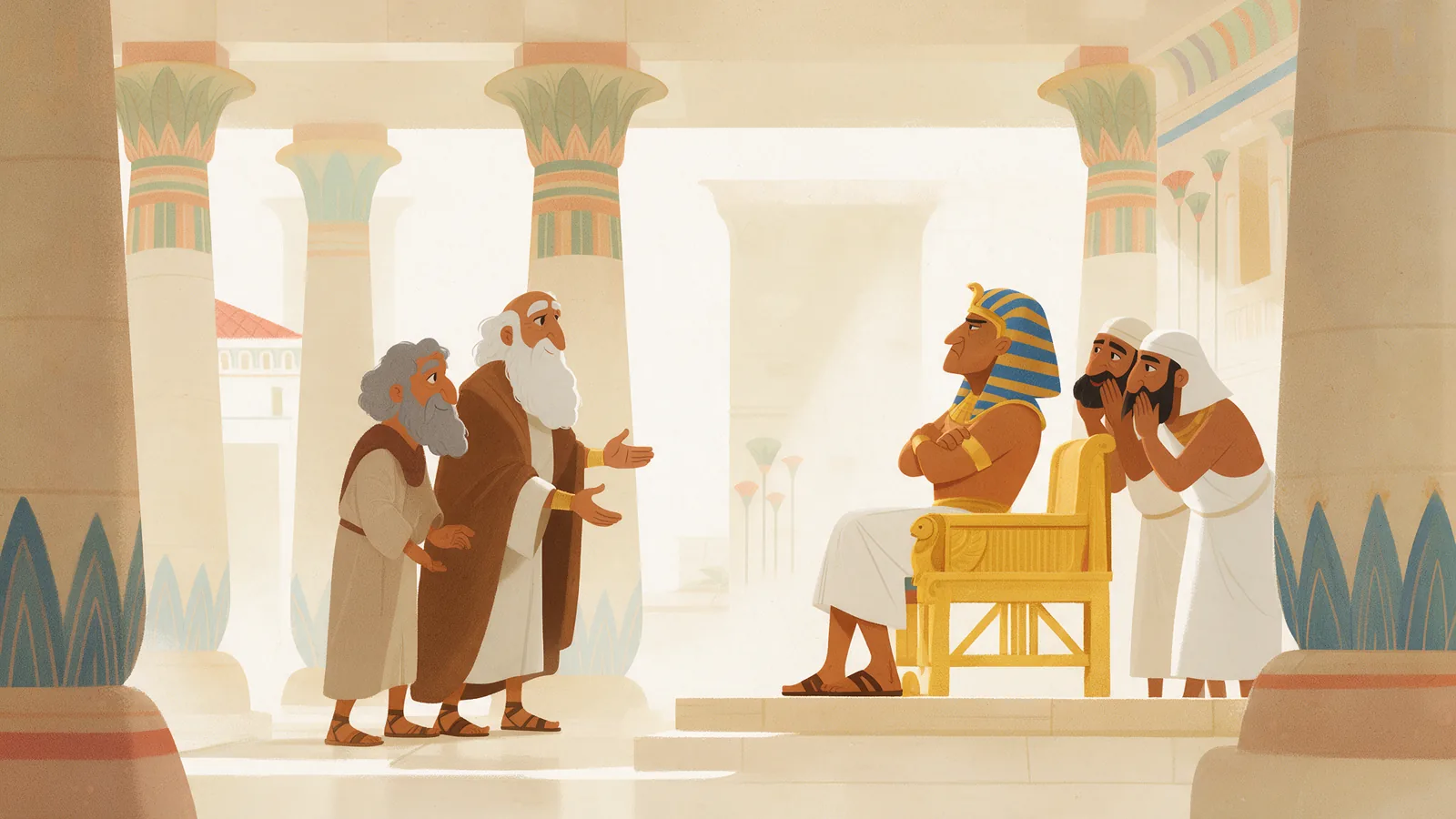
God sends Moses to tell Pharaoh: “Let my people go, that they may serve me!” But Pharaoh, with a hard heart, refuses. He thinks he is more powerful than God.
💬Why does Pharaoh say no?
🙅Cross your arms and shake your head no, like Pharaoh… then uncross them!
💧 The Nile water changes
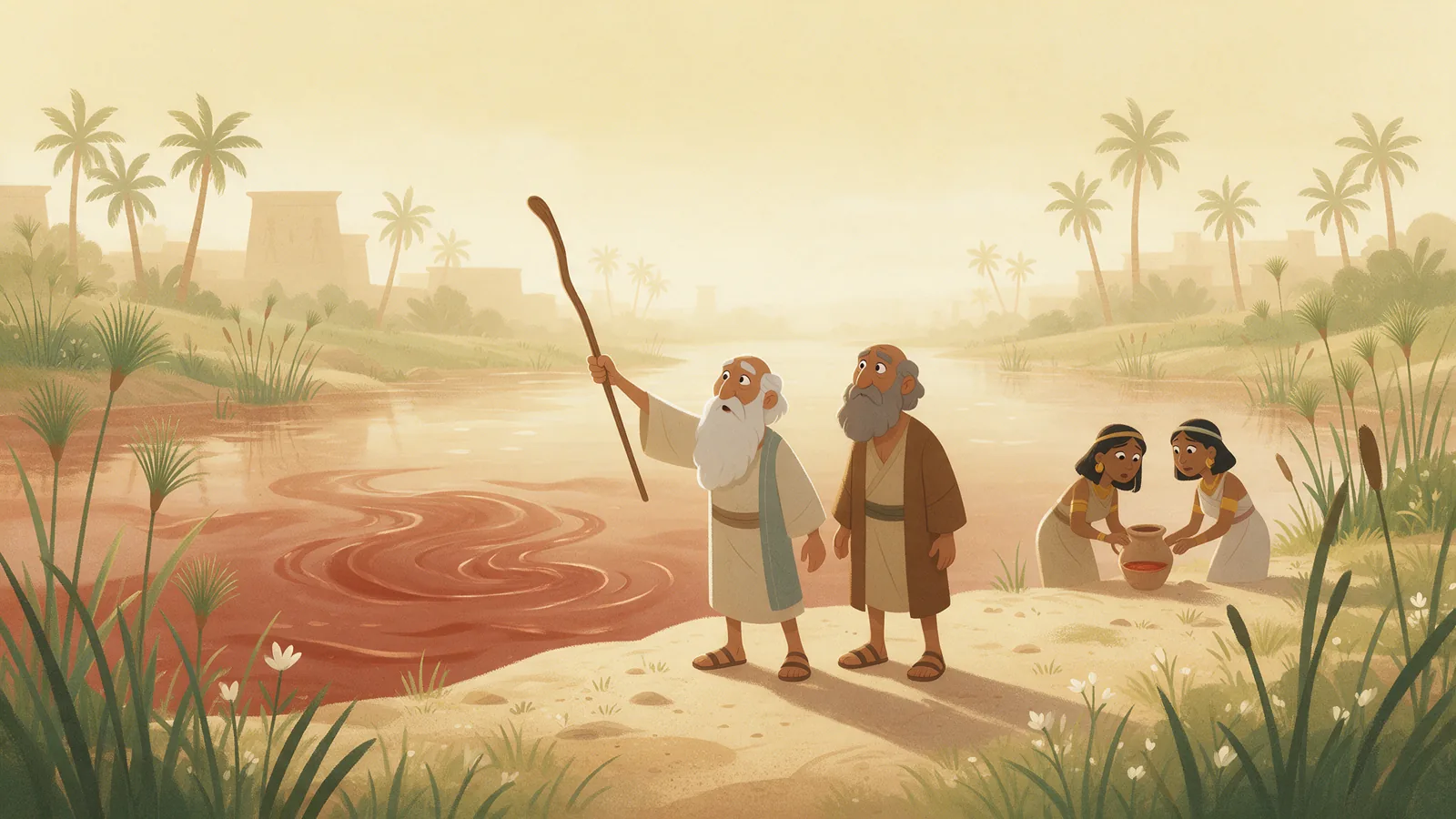
On God’s orders, Moses strikes the Nile River with his staff, and all the water turns into blood. The Egyptians can no longer drink the water from the river. But Pharaoh still refuses to let the people go.
💬Who is more powerful, Pharaoh or God?
💧Gently strike the floor with an imaginary staff.
🐸 The frogs
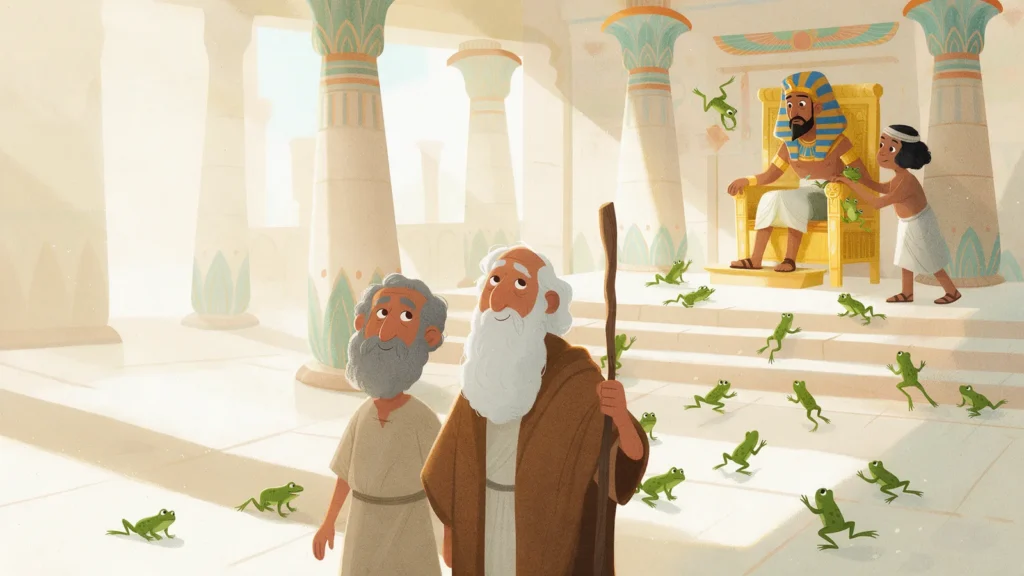
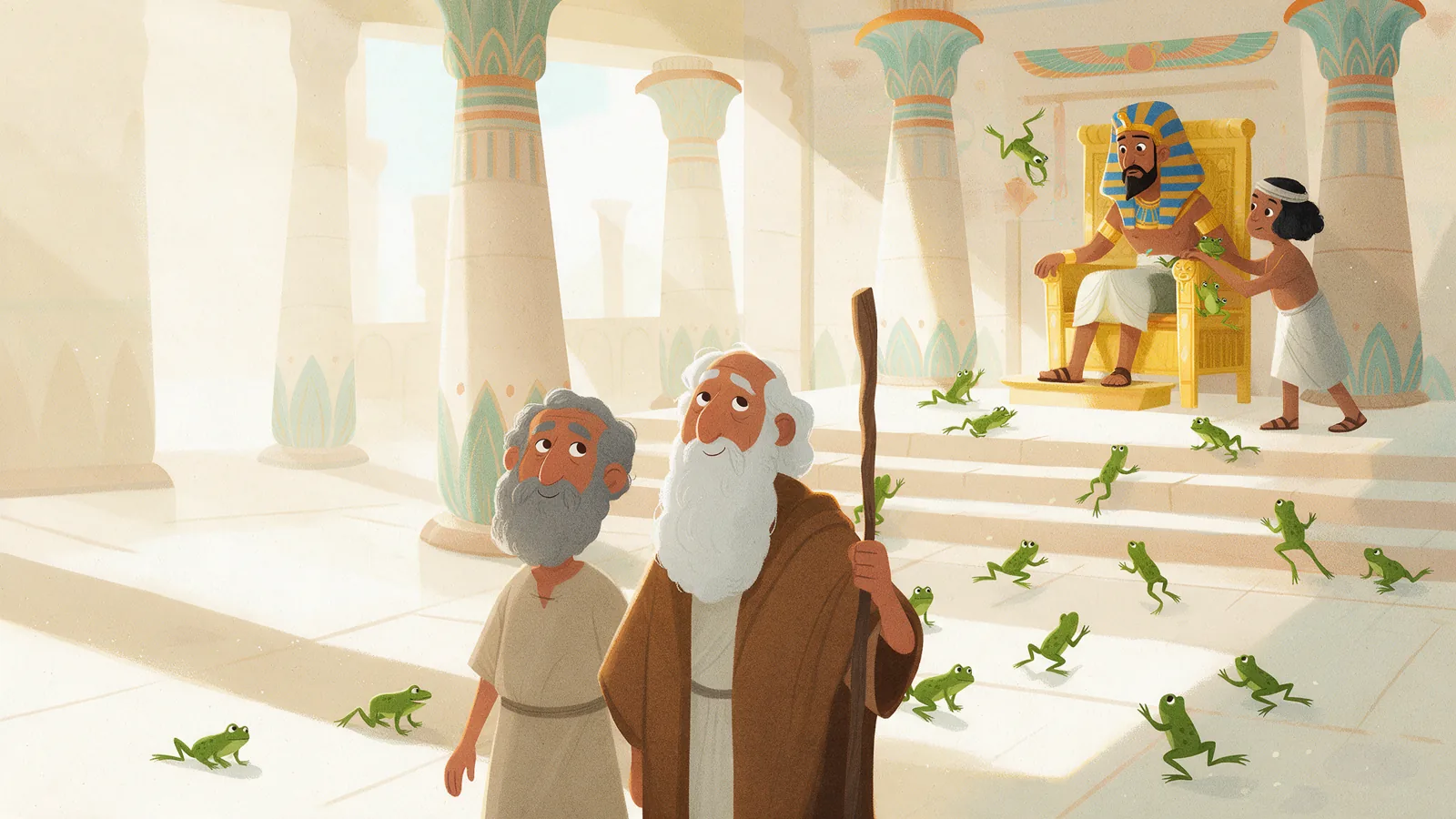
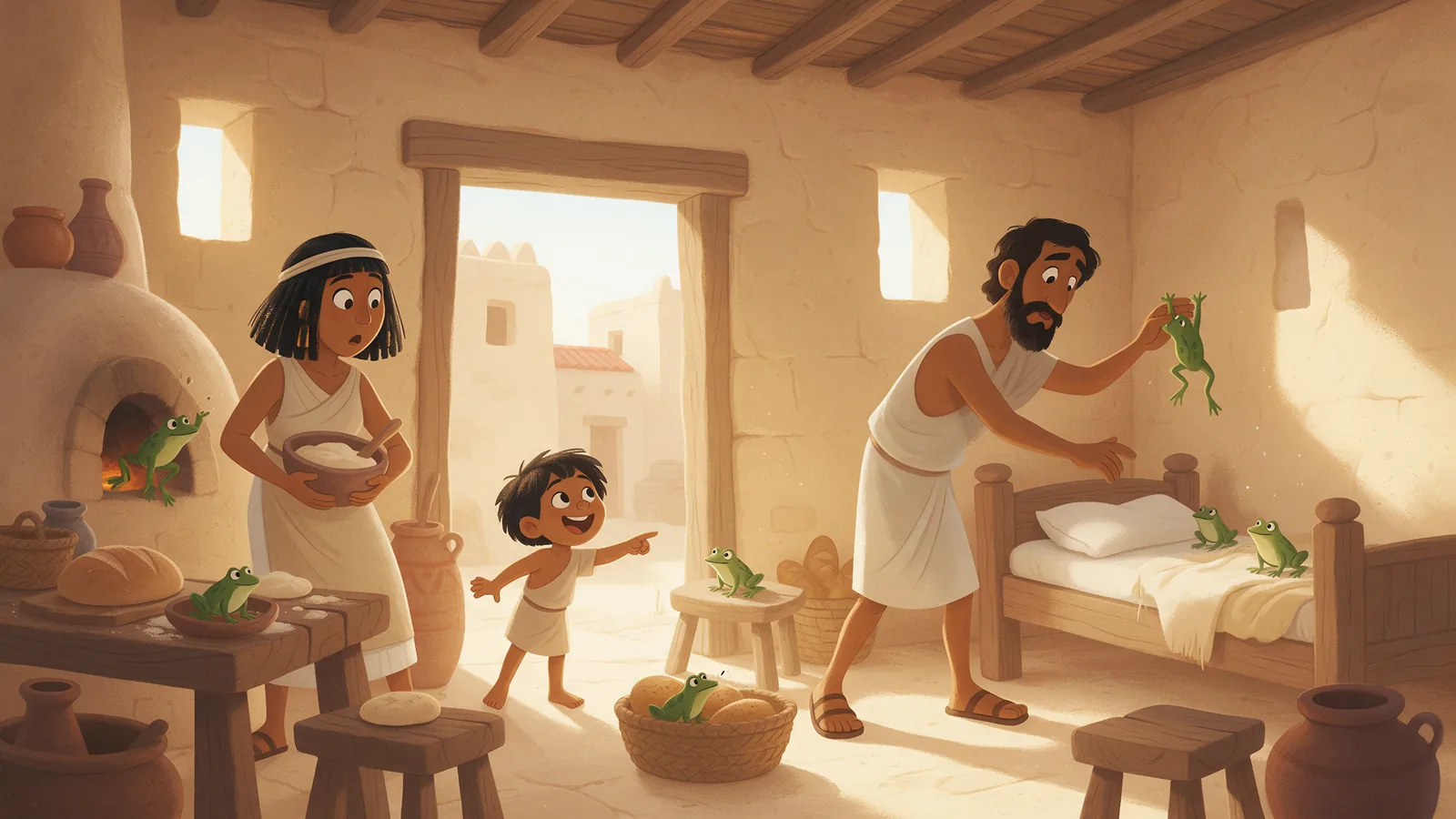
God makes frogs come up over the whole land: in the houses, in the beds, and even in the ovens! Pharaoh promises to free the Israelites, but when the frogs are gone, he changes his mind.
💬Does Pharaoh keep his promise?
🐸Hop like a frog over to your parent: ribbit, ribbit!
🪰 The flies
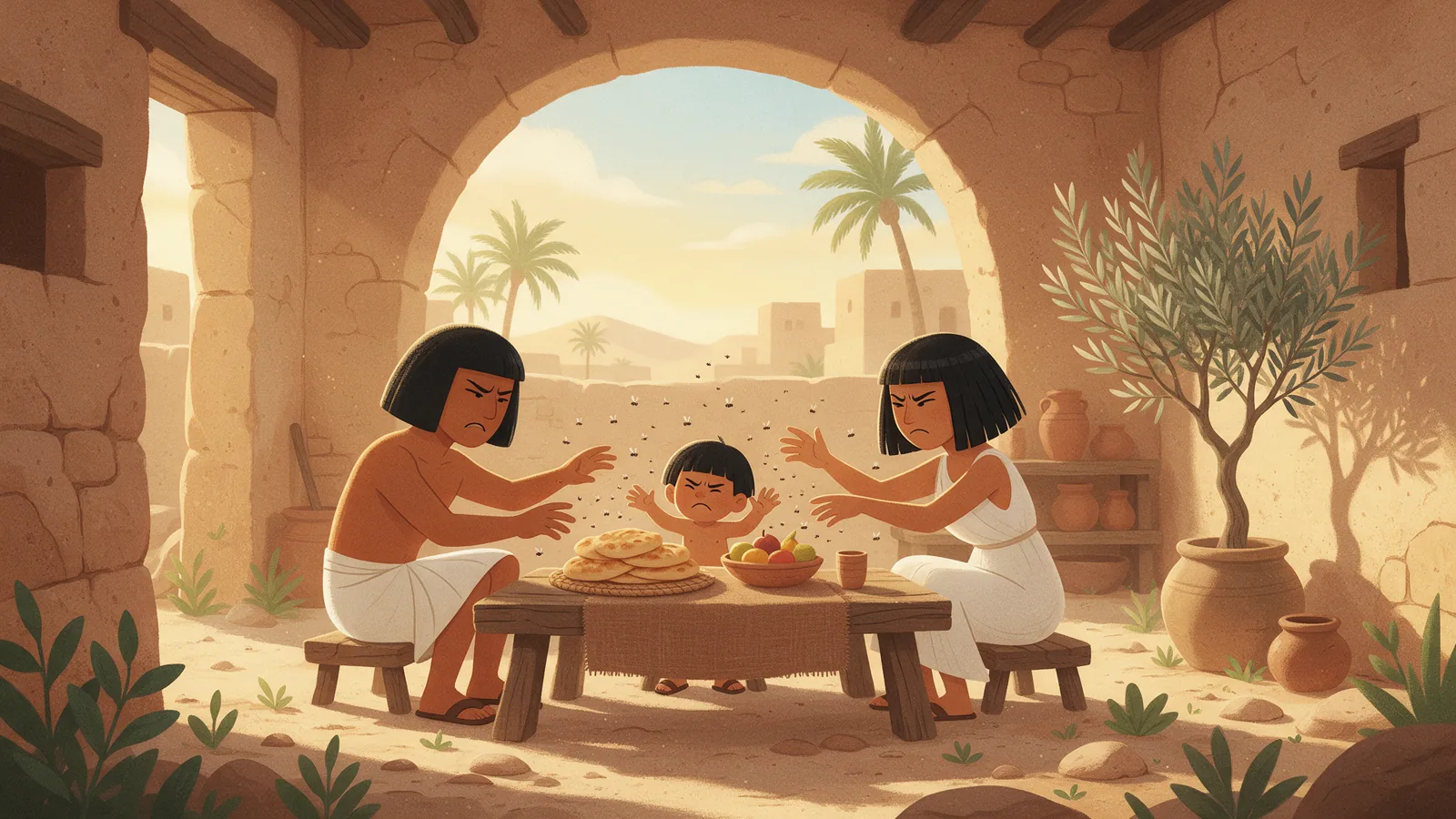
God sends flies everywhere in Egypt, so many that they fill the houses and cover everything. Pharaoh promises again to free the Israelites, but he refuses once more when the flies are gone.
💬Why do you think Pharaoh still does not want to listen?
🪰Shoo the flies around you: bzzz, go away!
🦗 The locusts
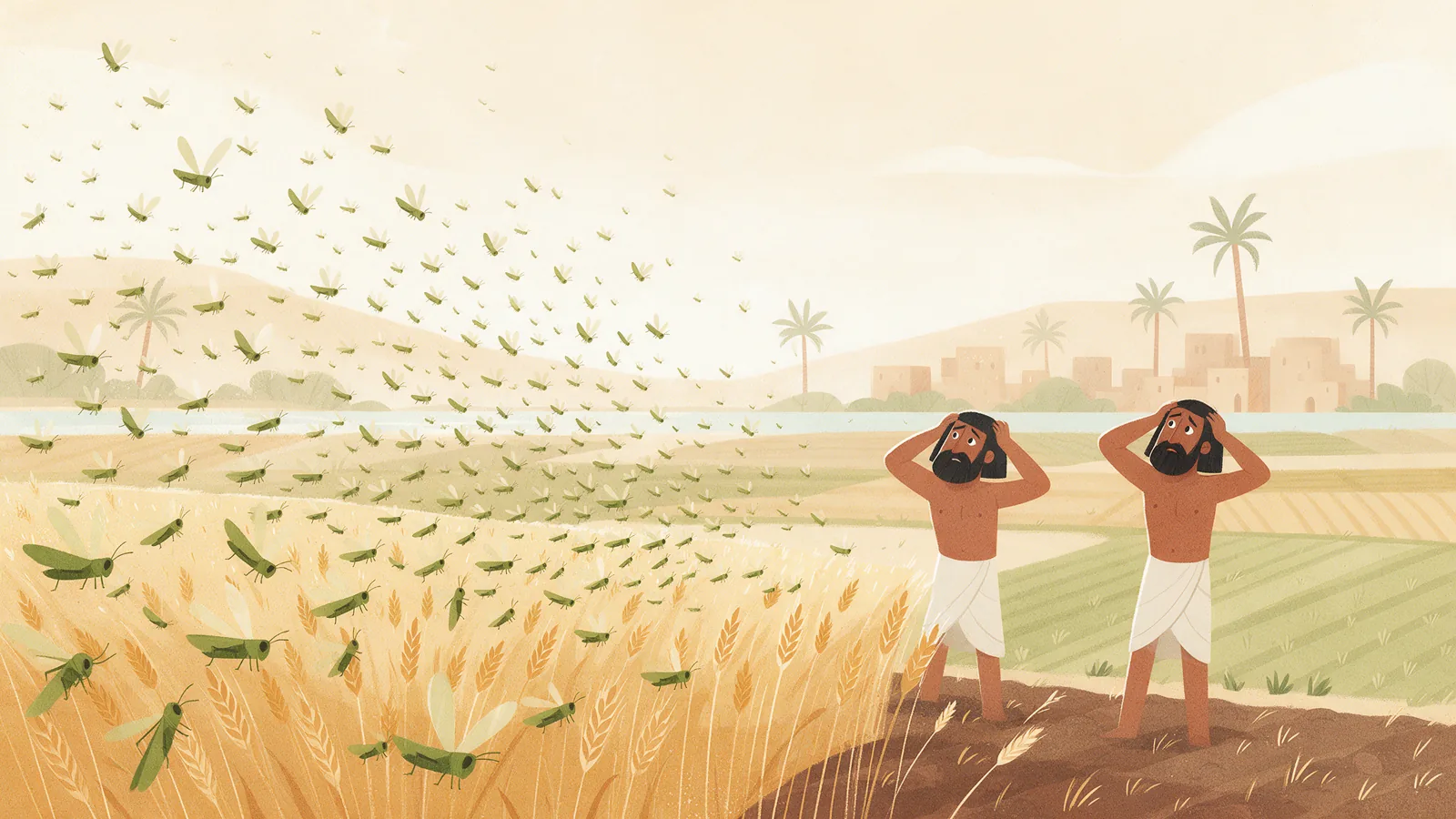
Next, God sends locusts that devour everything left after the hail. They cover the ground and destroy the crops. Pharaoh begs Moses once more, but he still refuses to free the people.
💬How can you tell that Pharaoh’s heart is hard?
🦗Jump from left to right like a locust!
🌑 The darkness
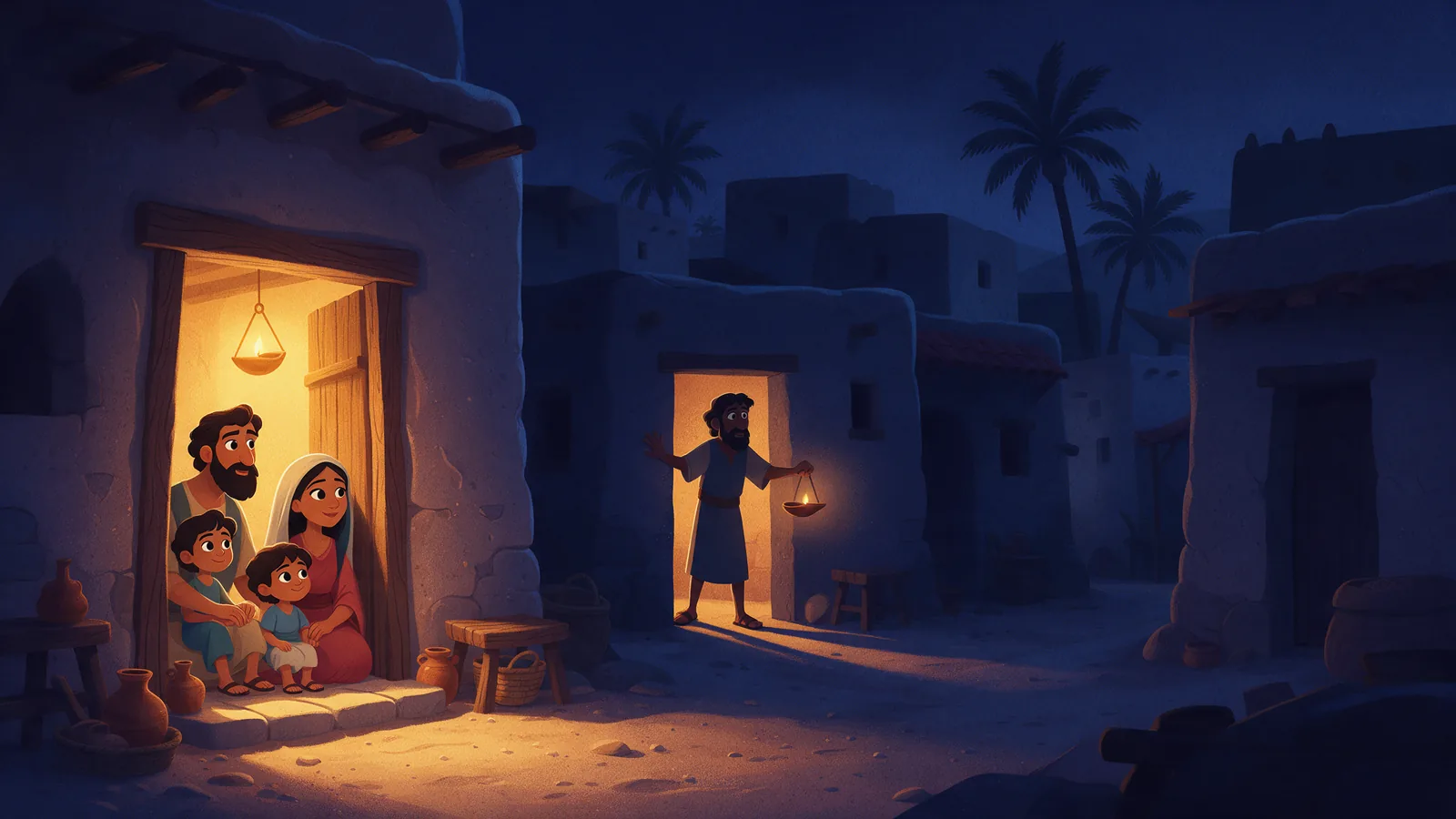
God sends a thick darkness over all of Egypt for three days. No one can see anything, and no one can leave their home. Only the Israelites have light in their homes.
💬What is God showing Pharaoh with the light in the Israelites’ homes?
💡Close your eyes for three seconds, then open them: what a beautiful light!
🎥 The Playmobil video
Watch the story in Playmobil
The First Passover, Playmobil Bible story (3 min)
🐸 The frogs
Chase the frogs out of the palace!
Frogs are swarming over Pharaoh’s palace! Tap each frog that comes out to chase it away, but do not tap the other characters.
🤔 Pharaoh promised to let the people go when the frogs were gone. What did he do?
💡 Pharaoh promised to free the Israelites, but once the plague was taken away, he changed his mind: his heart stayed hard.
Bravo, the palace is free of frogs! 🎉
🧩 The plagues in order
Put the plagues of Egypt in order
Tap the moments of the story, from the first to the last.
Perfect, you know the plagues of Egypt in order! 🎉
⭐ Easy questions
Choose one or more questions. A right answer = a star!
Why did Moses go to see Pharaoh?
To ask Pharaoh to let the people of Israel go so that they could serve God.
Why did God send the plagues on Egypt?
Pharaoh refused to let the Hebrew people go because they were his slaves and worked well.
What was the first plague God sent on Egypt?
The water of the Nile was turned into blood.
Was Pharaoh stronger than God?
No, he could do nothing against God, but he resisted and would not accept him.
⭐⭐ Medium questions
Choose one or more questions. A right answer = a star!
Name one of the plagues of Egypt.
Here are the 10 your child can choose from: Water turned into blood, frogs, lice, flies, disease on the livestock, boils, hail, locusts, darkness, the death of the firstborn.
How did Pharaoh react after each plague was taken away?
Pharaoh changed his mind and refused to free the people, in spite of his promises.
Why did Pharaoh refuse to free the Israelites, even after several plagues?
Pharaoh had a hard heart and did not want to lose the Israelites, because they were his slaves.
What did the locusts devour?
Everything that was left of the crops after the hail.
⭐⭐⭐ Impossible questions
Choose one or more questions. A right answer = a star!
What did the plagues show Pharaoh and the Egyptians?
The plagues showed that God is almighty, and that he can control people, animals, and nature.
Why did God protect the Israelites from the plagues that struck the Egyptians?
To show that his people were under his protection. The plagues were a judgment against the Egyptians.
Sum up how Pharaoh behaved during each plague.
He does not want to let the Hebrews go, he begs Moses to ask God to stop the current plague, promising to let them go, and then he changes his mind and flatly refuses to free the people.
How many plagues did God send on Egypt?
10!
💬 Parents’ questions
Questions for parents to talk over together.
Why did God send 10 different plagues instead of just one to convince Pharaoh?
Expected answer: To give him a chance to repent, to recognize that God is the true God, and that he must let the people God had chosen go.
How were the Israelites protected from the plagues, and what does that mean for us today?
Expected answer: The Israelites were protected from the plagues because they were under God’s protection; they were chosen. This shows us today that when we obey God and trust him, he takes care of us, his children, even in the middle of trials and hardships.
How can this story help you when you are waiting a long time to see a solution?
Expected answer: God is always at work to help us. Just as the Israelites waited a long time before being set free, we too must trust God, because he knows when and how to act for our good. This teaches us patience and faith, even when things seem hard.
What does Moses teach us in the face of Pharaoh’s constant refusal?
Expected answer: His perseverance and his faith in God. He went back to Pharaoh every time and did not give up until he saw God’s promise fulfilled and left with all the people.
🙏 Prayer time
“The LORD spoke to Moses, ‘Go in to Pharaoh, and tell him, “This is what the LORD says, ‘Let my people go, that they may serve me.’”’”
Exodus 8:1 (WEB)
Dear parents, this story shows God’s power and his desire to set his people free. Let’s encourage our children to pray with faith, knowing that God hears their prayers and acts to protect and free them. Teach them that God is always with them, even in hard times, and that he is greater than any obstacle.
🙏 Let’s pray that our children will trust in God’s power and know that God fights for them, as he did for the Israelites. 🙏🕊️💪
🎉 Well done, family!
God is greater than any obstacle!
You have experienced the whole story of the plagues of Egypt: the story, the video, the games, the questions, and the prayer. This week, remind your children that God hears their prayers and acts to protect them.
🎬 “And now, it’s your turn to play! Settle in comfortably as a family, as if you were on a TV set ready for a big adventure. Invite your child to get ready to listen to the Bible story and answer the questions, because today, they are the hero! 3… 2… 1… let the show begin!” 🎤📖😊
Parents, for the questions, feel free to choose one or more questions in each section to fit the game to your child.
Step 2: Reading the story
The people of Israel had been slaves in Egypt for many years. They worked hard under the orders of the king of Egypt, Pharaoh. But God had not forgotten his people. He sent Moses to tell Pharaoh: “Let my people go, that they may serve me!”
But Pharaoh, with a hard heart, refused to let the Israelites go. He thought he was more powerful than God and that he could keep them as slaves. So God showed his power to Pharaoh and to all of Egypt by sending plagues to set his people free.
Pharaoh refuses to let the people go.
1. The first plague: Water turned into blood
Moses, on God’s orders, struck the Nile River with his staff, and all the water turned into blood. The fish died, and the Egyptians could no longer drink the water from the river. But even after this plague, Pharaoh still refused to let the people go.
The water of the Nile changes color.
2. The second plague: Frogs
God told Moses to make frogs come up over the whole land. The frogs were everywhere: in the houses, in the beds, and even in the ovens! Pharaoh promised to free the Israelites, but once the plague was taken away, he changed his mind.
Frogs everywhere in the houses.
3. The third plague: Lice
God then sent lice over the whole land. The ground was covered with dust, and this dust turned into lice that swarmed over people and animals. But Pharaoh stayed stubborn.
4. The fourth plague: Flies
God sent flies everywhere in Egypt. There were so many that they filled the houses and covered everything. Once again, Pharaoh promised to free the Israelites, but he refused again after the flies were taken away.
Flies fill the houses.
5. The fifth plague: Disease on the livestock
God then struck the animals of Egypt with a deadly disease. All the animals of the Egyptians died, but the animals of the Israelites stayed healthy. Even so, Pharaoh still did not let the people go.
6. The sixth plague: Boils
Moses threw soot into the air, and it turned into painful boils on the skin of the Egyptians and their animals. But Pharaoh, even though he was suffering, dug in his heels and still refused to free the Israelites.
7. The seventh plague: Hail
God sent a terrible hailstorm, with hailstones so big that they destroyed the crops and the trees and killed the people and animals who were outside. It was a storm like Egypt had never seen. Pharaoh begged Moses to pray for the hail to stop, but as soon as it stopped, he changed his mind again.
8. The eighth plague: Locusts
Next, God sent locusts that devoured everything left after the hail. They covered the ground and destroyed the crops. Pharaoh begged Moses once more, but he still refused to free the people.
Locusts devour the crops.
9. The ninth plague: Darkness
God sent a thick darkness over all of Egypt for three days. No one could see anything, and no one could leave their home. Only the Israelites had light in their homes. Pharaoh became even more furious, but he refused again.
In the Israelites’ homes, there is light.
God was showing Pharaoh that nothing could stop his will to set his people free. But Pharaoh’s heart stayed hard. After these nine plagues, God was preparing one last plague, even more terrible, to convince Pharaoh.
Bible reference: Exodus 7-10
Step 3: The questions
Easy question
Difficulty: ★☆☆☆
Easy question background music
Why did Moses go to see Pharaoh?
Answer: To ask Pharaoh to let the people of Israel go so that they could serve God.
Why did God send the plagues on Egypt?
Answer: Pharaoh refused to let the Hebrew people go because they were his slaves and worked well.
What was the first plague God sent on Egypt?
Answer: The water of the Nile was turned into blood.
Was Pharaoh stronger than God?
Answer: No, he could do nothing against God, but he resisted and would not accept him.
Correct answer jingle
Wrong answer jingle
Medium question
Difficulty: ★★☆☆
Medium question background music
Name one of the plagues of Egypt.
Answer: Here are the 10 your child can choose from: Water turned into blood, frogs, lice, flies, disease on the livestock, boils, hail, locusts, darkness, the death of the firstborn.
How did Pharaoh react after each plague was taken away?
Answer: Pharaoh changed his mind and refused to free the people, in spite of his promises.
Why did Pharaoh refuse to free the Israelites, even after several plagues?
Answer: Pharaoh had a hard heart and did not want to lose the Israelites, because they were his slaves.
What did the locusts devour?
Answer: Everything that was left of the crops after the hail.
Correct answer jingle
Wrong answer jingle
The impossible question
Difficulty: ★★★☆
The impossible question background music
What did the plagues show Pharaoh and the Egyptians?
Answer: The plagues showed that God is almighty, and that he can control people, animals, and nature.
Why did God protect the Israelites from the plagues that struck the Egyptians?
Answer: To show that his people were under his protection. The plagues were a judgment against the Egyptians.
Sum up how Pharaoh behaved during each plague.
Answer: He does not want to let the Hebrews go, he begs Moses to ask God to stop the current plague, promising to let them go, and then he changes his mind and flatly refuses to free the people.
How many plagues did God send on Egypt?
Answer: 10!
Correct answer jingle
Wrong answer jingle
Parents’ question
Difficulty: ★★★★
Parents’ question background music
Why did God send 10 different plagues instead of just one to convince Pharaoh?
Expected answer: To give him a chance to repent, to recognize that God is the true God, and that he must let the people God had chosen go.
How were the Israelites protected from the plagues, and what does that mean for us today?
Expected answer: The Israelites were protected from the plagues because they were under God’s protection; they were chosen. This shows us today that when we obey God and trust him, he takes care of us, his children, even in the middle of trials and hardships.
How can this story help you when you are waiting a long time to see a solution?
Expected answer: God is always at work to help us. Just as the Israelites waited a long time before being set free, we too must trust God, because he knows when and how to act for our good. This teaches us patience and faith, even when things seem hard.
What does Moses teach us in the face of Pharaoh’s constant refusal?
Expected answer: His perseverance and his faith in God. He went back to Pharaoh every time and did not give up until he saw God’s promise fulfilled and left with all the people.
Correct answer jingle
Wrong answer jingle
Prayer time
Prayer background music
Dear parents, this story shows God’s power and his desire to set his people free. Let’s encourage our children to pray with faith, knowing that God hears their prayers and acts to protect and free them. Teach them that God is always with them, even in hard times, and that he is greater than any obstacle.
Let’s pray that our children will trust in God’s power and know that God fights for them, as he did for the Israelites. 🙏🕊️💪